


Recent Backups
This guide explains how to view and manage BackupSessions — individual backup job executions triggered by BackupConfigurations or manually created on-demand. Each BackupSession represents a single point-in-time snapshot of your database.
1. Getting Started
Navigate to Backups in the left sidebar and select Recent Backups. This opens the BackupSession list page showing all backup executions across your cluster.
2. BackupSession List
The list page displays all BackupSessions in your cluster, both scheduled (from BackupConfigurations) and on-demand. Use the Select Namespace dropdown to filter by namespace.
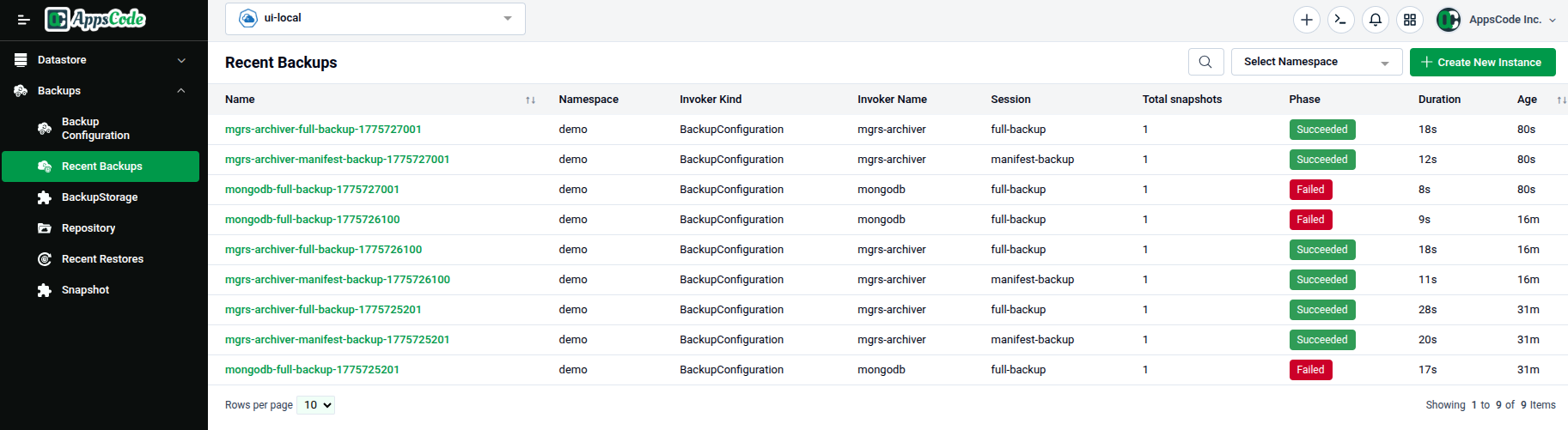
| Column | Description |
|---|---|
| Name | The BackupSession resource name. |
| Namespace | The namespace where it is deployed. |
| BackupConfiguration | The BackupConfiguration that created this session (if applicable). |
| Invoker Kind | The resource type that triggered the session (BackupConfiguration or manual). |
| Invoker Name | The name of the invoker resource. |
| Session | The session name within the configuration (e.g., full-backup). |
| Timeout | Maximum time allowed for the session to complete. |
| Phase | Current status (e.g., Succeeded, Running, Failed). |
| Duration | Elapsed time for the session operation. |
| Age | How long ago the session was created. |
3. Viewing a BackupSession
Click on any BackupSession name in the list to open its detail page. The detail page shows the session's metadata, linked configuration, and all snapshots created.
3.1 - Overview
The detail page opens on the Overview tab showing:
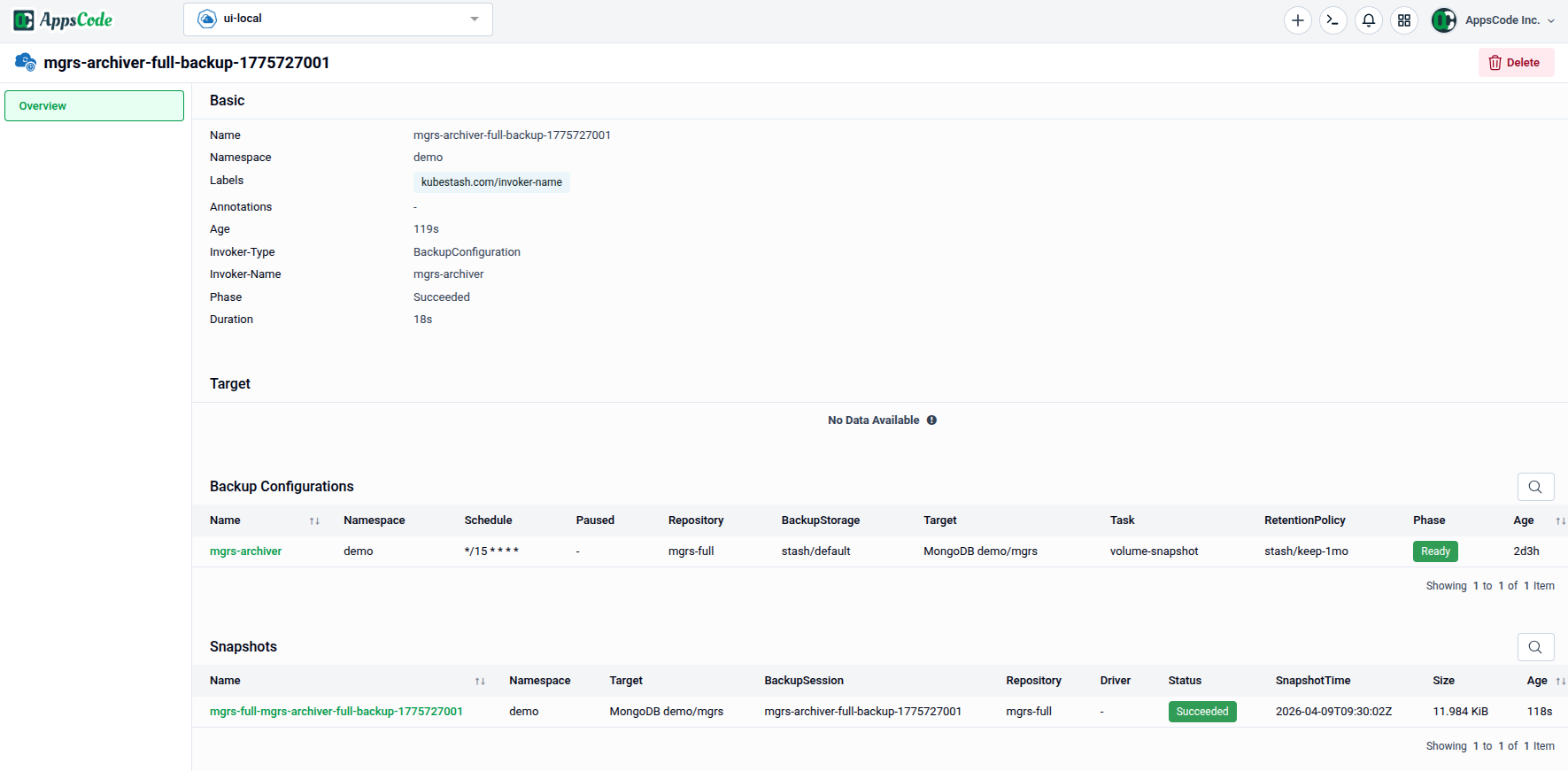
Basic — Core metadata for the session:
| Field | Description |
|---|---|
| Name | The BackupSession resource name. |
| Namespace | The namespace it belongs to. |
| Labels | Key-value labels attached to the resource. |
| Annotations | Key-value annotations linking to invoker and configuration. |
| UID | The unique Kubernetes identifier. |
| Phase | Current lifecycle phase (e.g., Succeeded, Running, Failed). |
| Timeout | Maximum time allowed for the session. |
| Session | The session name within the BackupConfiguration. |
Backup Configuration — Reference to the BackupConfiguration that created this session:
| Column | Description |
|---|---|
| Name | The BackupConfiguration resource name. |
| Namespace | Namespace of the BackupConfiguration. |
| Invoker Kind | Always BackupConfiguration for scheduled sessions. |
| Invoker Name | Name of the BackupConfiguration invoker. |
| Target | The database being backed up. |
| Task | The backup task executed (e.g., logical-backup). |
| Repository | Where the backup snapshots are stored. |
| Status | Current status of the linked configuration. |
| Age | Age of the BackupConfiguration resource. |
Snapshots — Individual snapshots created during this session:
| Column | Description |
|---|---|
| Name | The snapshot resource name. |
| Namespace | Namespace of the snapshot. |
| Repository | The repository storing this snapshot. |
| Size | Size of the snapshot data. |
| Phase | Status of the snapshot (e.g., Succeeded, Failed). |
| Creation Timestamp | When the snapshot was created. |
| Status | Verification status (OK or error message). |
4. Creating a BackupSession
To manually trigger an on-demand backup (without waiting for a scheduled BackupConfiguration), click Create New Instance from the Recent Backups list page.
The Create BackupSession form will open with the following fields:
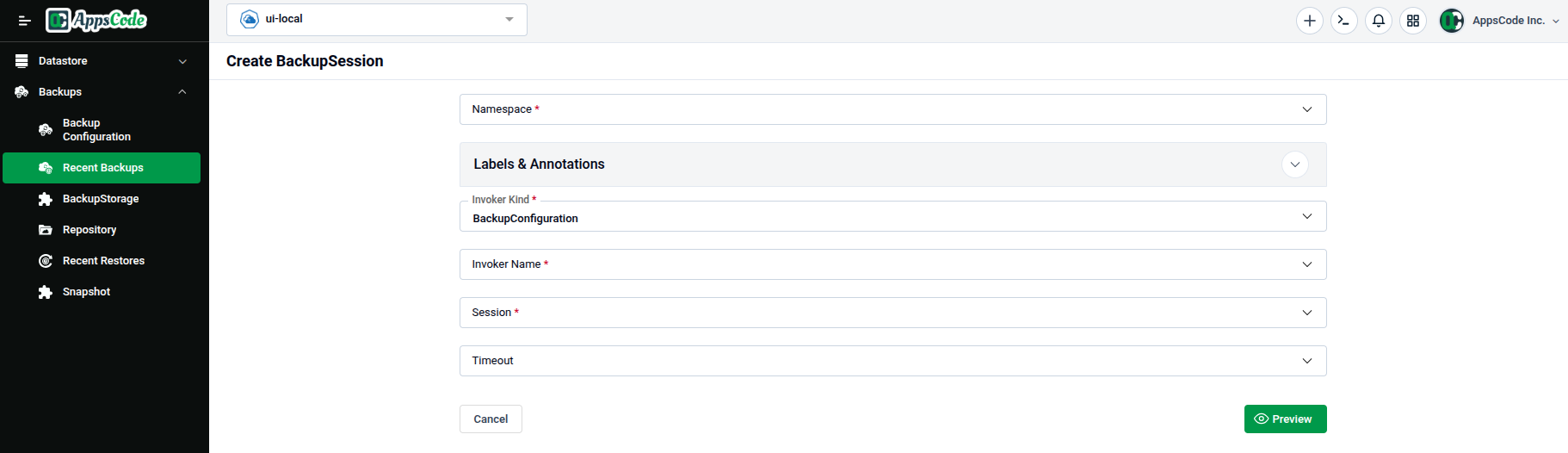
4.1 - Basic Fields
| Field | Description |
|---|---|
| Namespace | The Kubernetes namespace where the BackupSession will be created. Required. |
| Labels & Annotations | Optional metadata key-value pairs for organization and filtering. |
| Invoker Kind | The type of resource triggering this session. For manual backups, set to BackupConfiguration. Required. |
| Invoker Name | The name of the BackupConfiguration resource to use for this on-demand backup. Required. |
| Session | The session name within the BackupConfiguration (e.g., full-backup). Required. |
| Timeout | Maximum time allowed for the backup to complete (e.g., 2h). Optional; defaults to the BackupConfiguration's timeout. |
Note: The Invoker Kind and Invoker Name determine which BackupConfiguration's settings (storage backend, addon, tasks) are used for the on-demand backup.
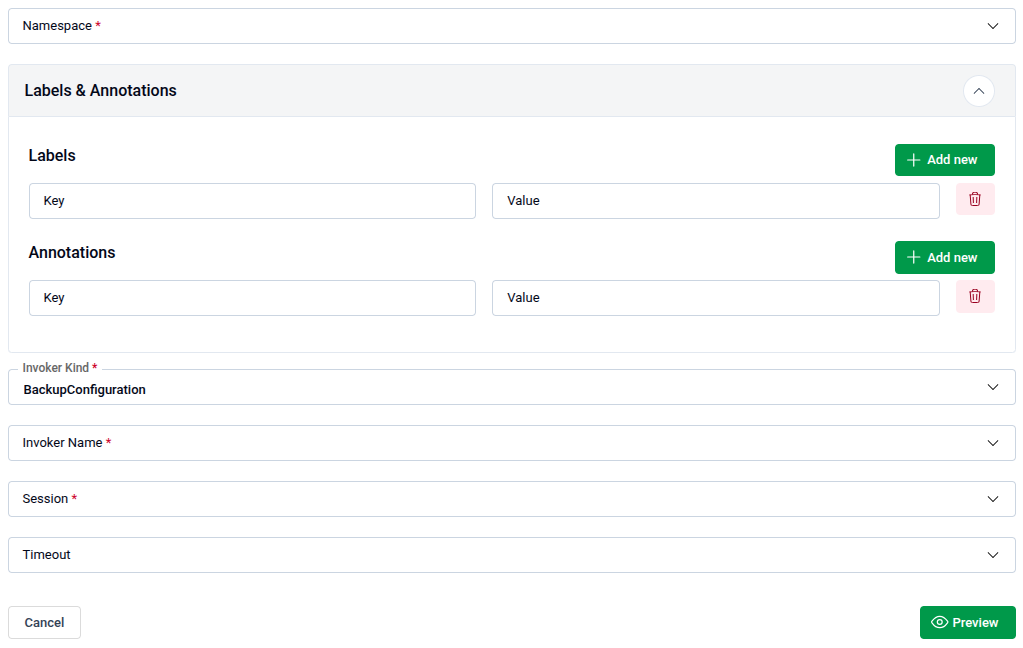
4.2 - Labels & Annotations
Use the Labels & Annotations section to attach custom metadata:
- Use + Add new under Labels to add key-value label pairs.
- Use + Add new under Annotations to add key-value annotation pairs.
- Use the delete icon on any row to remove an entry.
5. Preview and Submit
Once all required fields are filled, click Preview to review the generated BackupSession manifest before applying it.
- The manifest is shown in YAML view by default. Use the JSON button to switch to JSON format if preferred.
- Use the Copy button to copy the manifest to your clipboard.
- Click Previous to go back and adjust your settings if needed.
Tip: You can directly edit the YAML or JSON on the Preview page before submitting. This is useful for making precise adjustments beyond what the form fields expose.
- Submit: Once satisfied, click Submit to create the BackupSession in your cluster.
Note: After submitting, the backup job will begin immediately using the configuration and settings from the specified BackupConfiguration and Session.
Quick Reference
| Action | How to do it |
|---|---|
| View all BackupSessions | Backups → Recent Backups |
| Filter by namespace | Use the Select Namespace dropdown on the list page |
| View session detail | Click on the BackupSession name in the list |
| Check snapshot status | Detail page → Snapshots table |
| View linked configuration | Detail page → Backup Configuration table |
| Check session phase | Detail page → Basic section → Phase field |
| Open the create form | List page → Create New Instance |
| Add labels or annotations | Labels & Annotations → + Add new → enter Key and Value |
| Select a configuration | Invoker Name dropdown → choose a BackupConfiguration |
| Select a session | Session dropdown → choose session from the configuration |
| Set operation timeout | Timeout field → enter duration (e.g., 2h) |
| Review before creating | Click Preview |
| Edit manifest directly | Use the YAML / JSON toggle on the Preview page |
| Trigger an on-demand backup | Click Submit on the Preview page |