


Manage Feature Sets
Feature Sets are groups of AppsCode product capabilities that you can install or remove on any connected cluster. This page walks you through all 18 available Feature Sets and shows a step-by-step enable flow for the two most commonly used ones: Backup & Recovery and Databases.
Available Feature Sets at a Glance
The Feature Sets grid on the Cluster Overview page shows all available product modules and their current installation status.
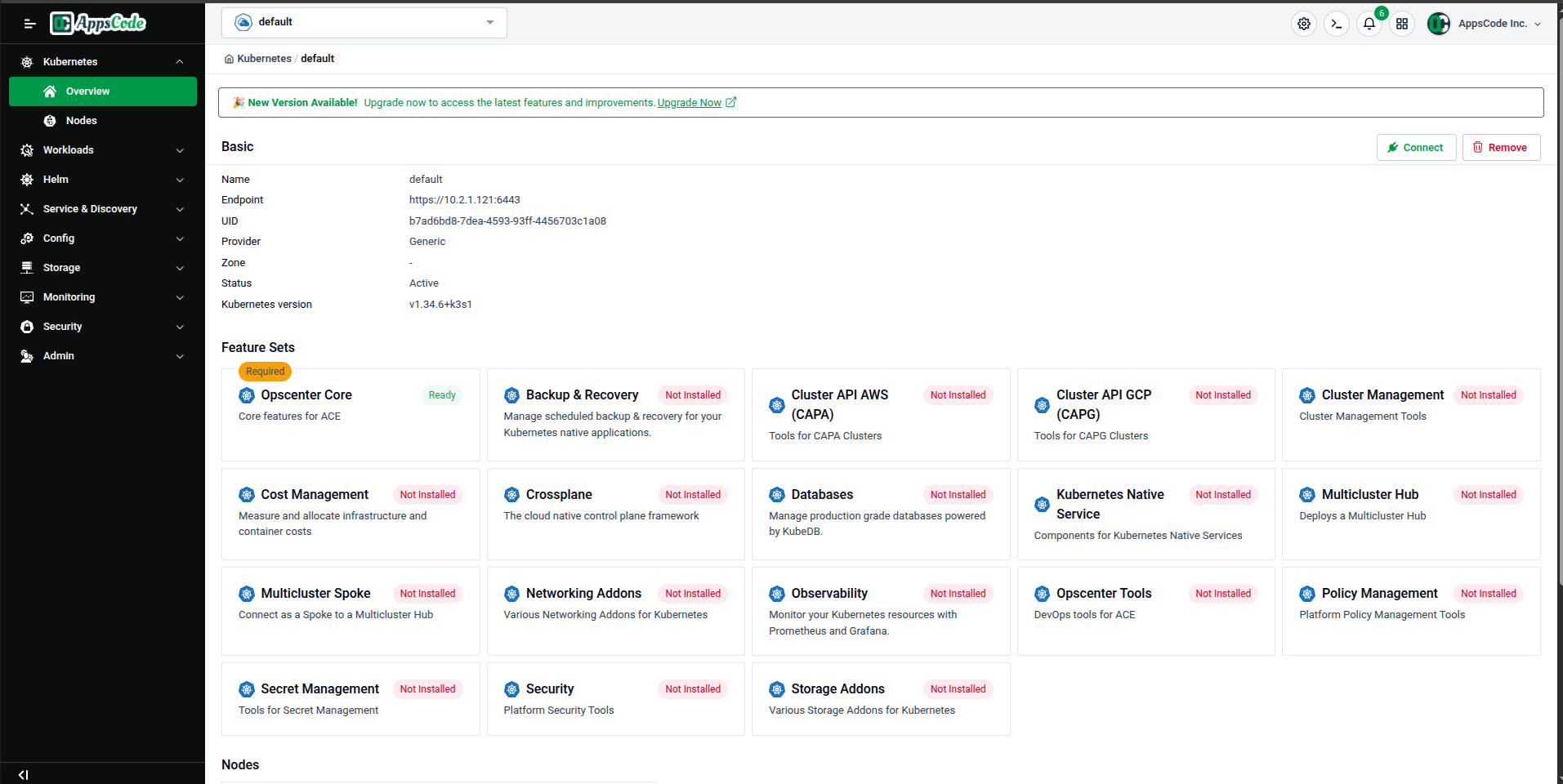
| Feature Set | Description |
|---|---|
| Opscenter Core (Required) | Core platform capabilities — must be installed first. All other Feature Sets depend on it. |
| Backup & Recovery | Scheduled backup and recovery for Kubernetes-native applications using KubeStash (Stash 2.0). |
| Cluster API AWS (CAPA) | Lifecycle management tools for clusters running on AWS via the Cluster API. |
| Cluster API GCP (CAPG) | Lifecycle management tools for clusters running on GCP via the Cluster API. |
| Cluster Management | Cluster provisioning and management tools. |
| Cost Management | Measure and allocate infrastructure and container resource costs. |
| Crossplane | The cloud-native control plane framework for infrastructure as code. |
| Databases | Production-grade database management powered by KubeDB — supports Elasticsearch, Kafka, MongoDB, MySQL, Postgres, Redis, and more. |
| Kubernetes Native Service | Components for building Kubernetes-native service patterns. |
| Multicluster Hub | Deploy and manage a central hub for a fleet of clusters. |
| Multicluster Spoke | Connect this cluster as a spoke to an existing Multicluster Hub. |
| Networking Addons | Various networking plugins and extensions for Kubernetes. |
| Observability | Cluster monitoring, metrics, and dashboards using Prometheus and Grafana. |
| Opscenter Tools | DevOps tooling and management utilities for ACE. |
| Policy Management | Platform-level policy enforcement tools. |
| Secret Management | Tools for secure secret storage and distribution across namespaces. |
| Security | TLS certificate management, secret scanning, and image vulnerability tooling. |
| Storage Addons | Additional storage drivers and integrations for Kubernetes. |
Tip: Feature Sets marked Required must be installed before enabling any others. Opscenter Core is always required first.
Once you have enabled some Feature Sets, the Cluster Overview grid reflects the updated statuses — cards previously showing Not Installed will update to Ready.
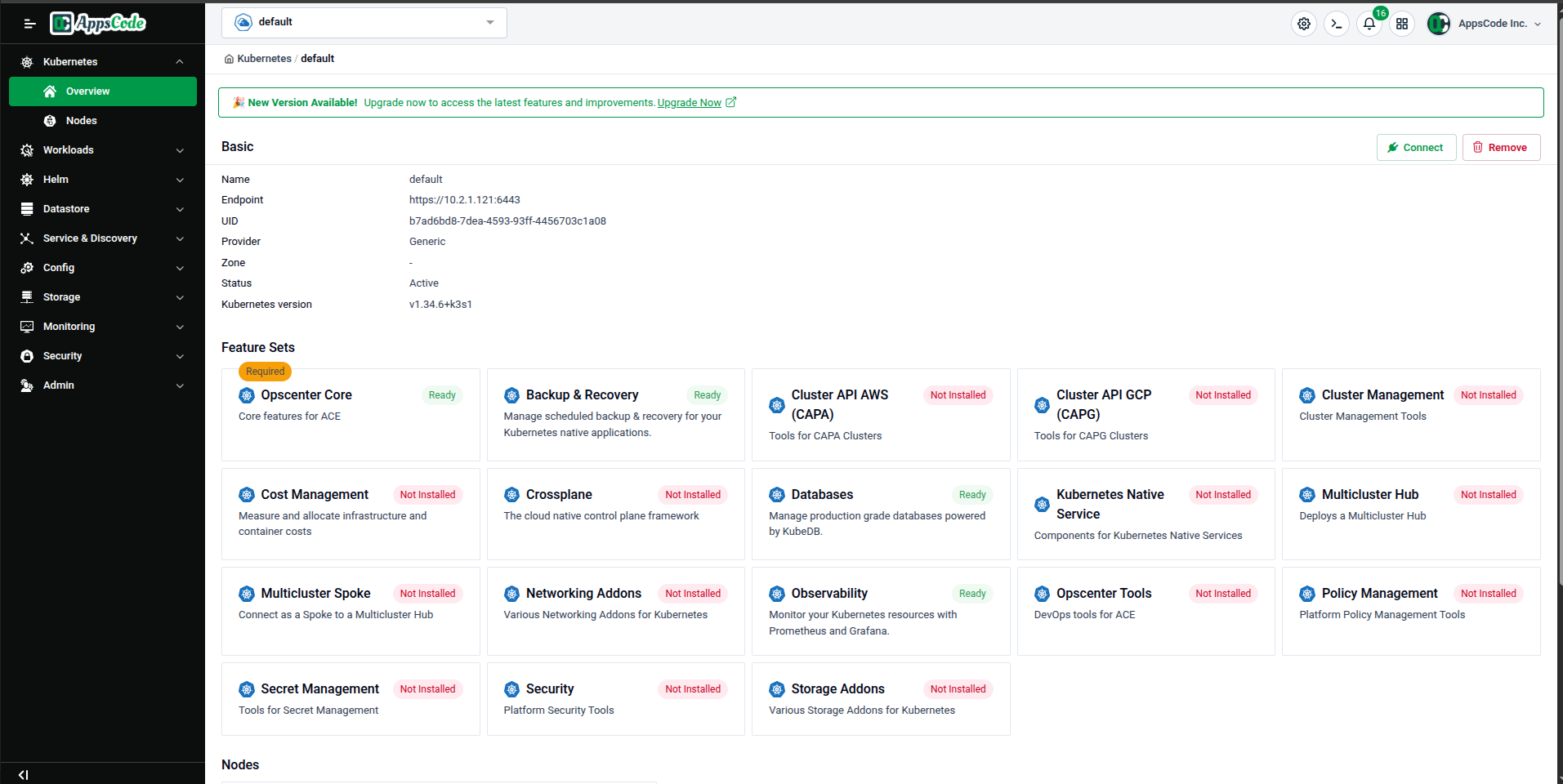
Feature Set: Backup & Recovery
Backup & Recovery enables scheduled backup and recovery for Kubernetes-native applications using KubeStash (formerly Stash). It consists of three components: Stash 2.0 (aka KubeStash), Stash Presets, and Stash.
Step 1 — Open the Backup & Recovery Feature Set Page
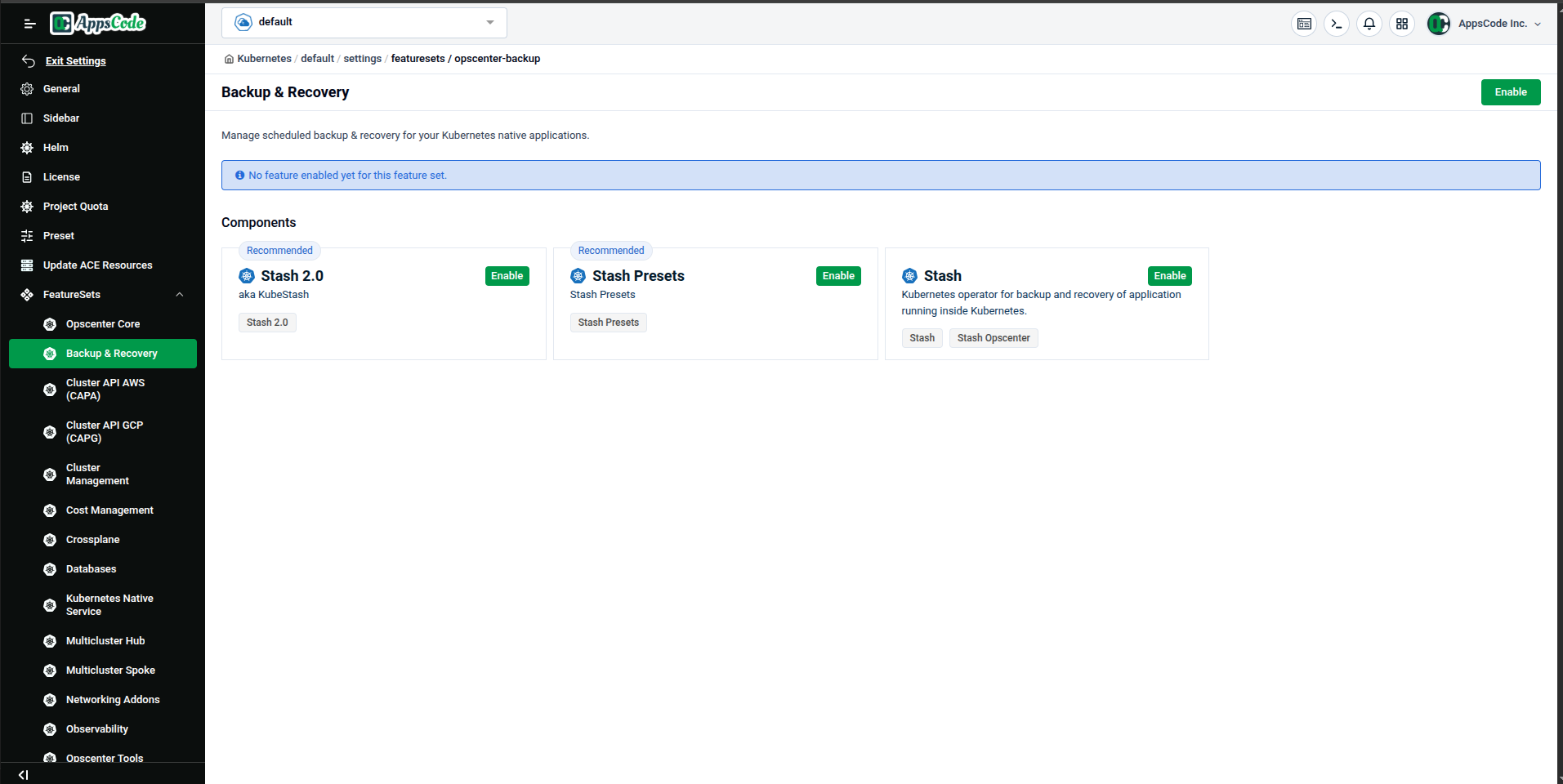
From the Cluster Overview, click the Backup & Recovery card. The Feature Set page opens, showing:
- A blue info banner: "No feature enabled yet for this feature set."
- A Components section with three cards: Stash 2.0 (Recommended), Stash Presets (Recommended), and Stash
- A green Enable button on each component card, and a master Enable button at the top-right
Step 2 — Select Components and Configure the Preset
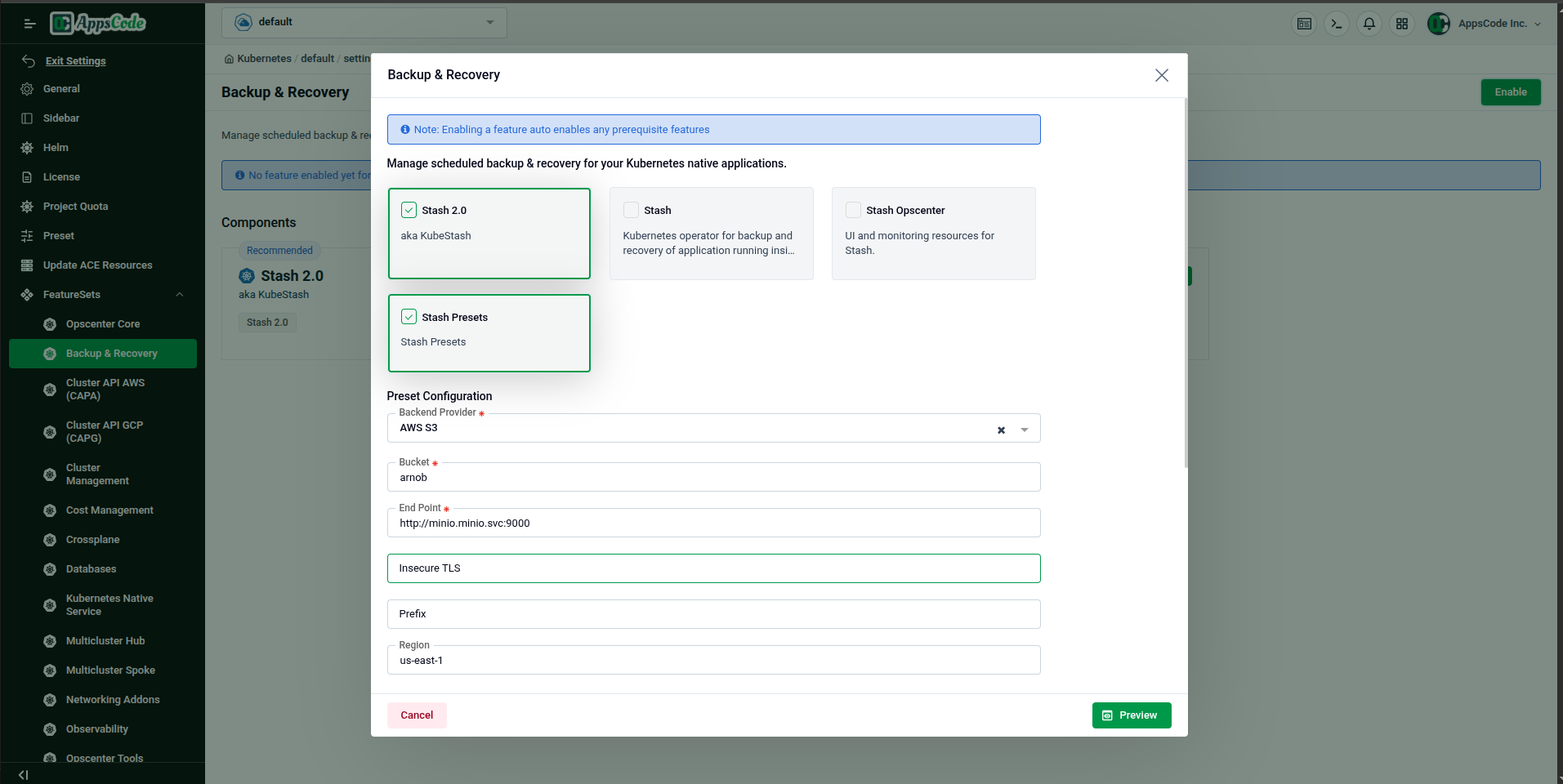
Click the top-right Enable button to open the Enable Feature Set modal. The modal shows:
- A checklist of available components — select the ones you want to enable (e.g., Stash 2.0 and Stash Presets are pre-checked as Recommended)
- A Preset Configuration section with required fields:
- Backend Provider — the storage backend (e.g., AWS S3, GCS, Azure)
- Bucket — the bucket or container name
- End Point — the storage endpoint URL
- Insecure TLS — toggle if using insecure TLS
- Prefix — optional path prefix inside the bucket
- Region — the storage region (e.g.,
us-east-1)
Note: Enabling a feature auto-enables any prerequisite features — a blue banner at the top of the modal confirms this.
Fill in all required fields and click Preview to advance.
Step 3 — Review the Generated Helm Values
The modal advances to the Values Preview step:
- The left panel lists each generated Helm release file (e.g.,
helm_release_kubestash.yaml,helm_release_stash_presets.yaml) - The right panel shows the full YAML values for the selected file
- Switch between Edit and Preview Changes tabs to review or compare against defaults
- Click Compare default values to diff against the out-of-the-box configuration
- Click ← Previous to go back, or Deploy to apply
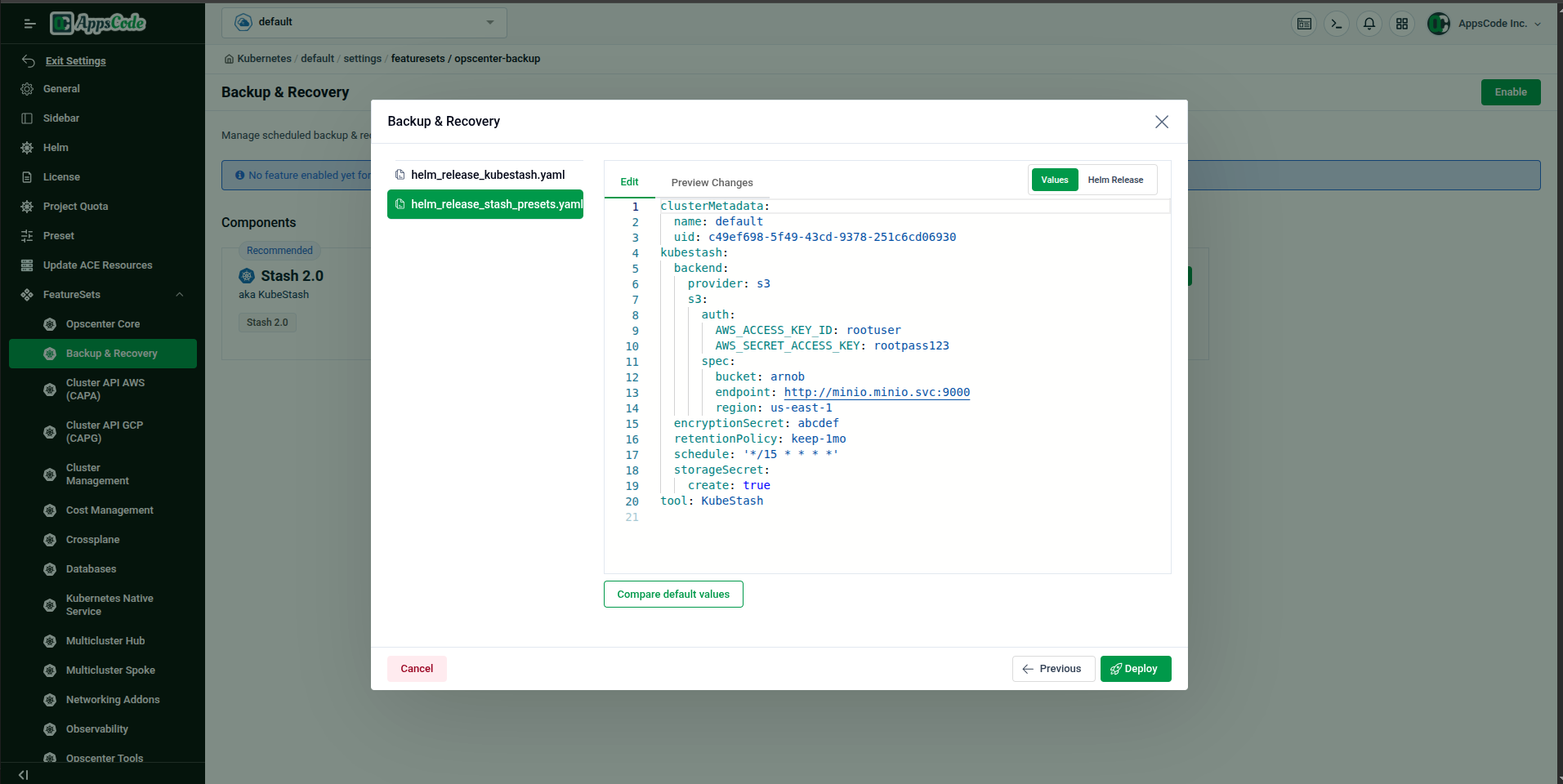
Step 4 — Deploy and Monitor Progress
After clicking Deploy, the modal shows a live deploy log. You will see output like:
Enabling FeatureSet `opscenter-backup` started!Wait for the log stream to complete, then close the modal.
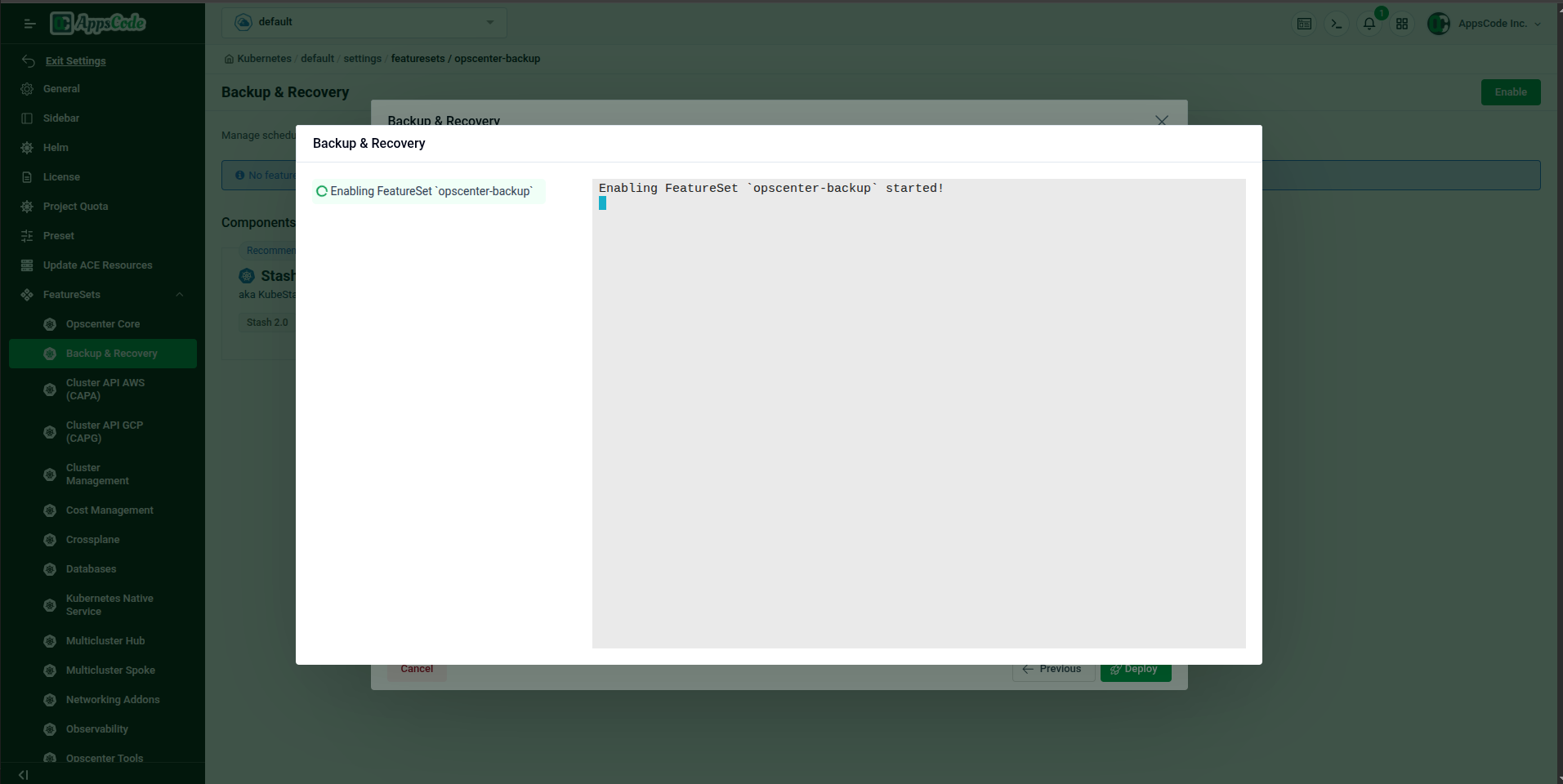
Step 5 — Verify the Feature Set Status
After deployment, the Feature Set page shows the updated component statuses. If a dependency is still being pulled, a banner reads: "Feature 'stash-presets' is enabled but not ready." The affected component cards show a ⚠️ warning icon with a tooltip "Required workload does not exist."
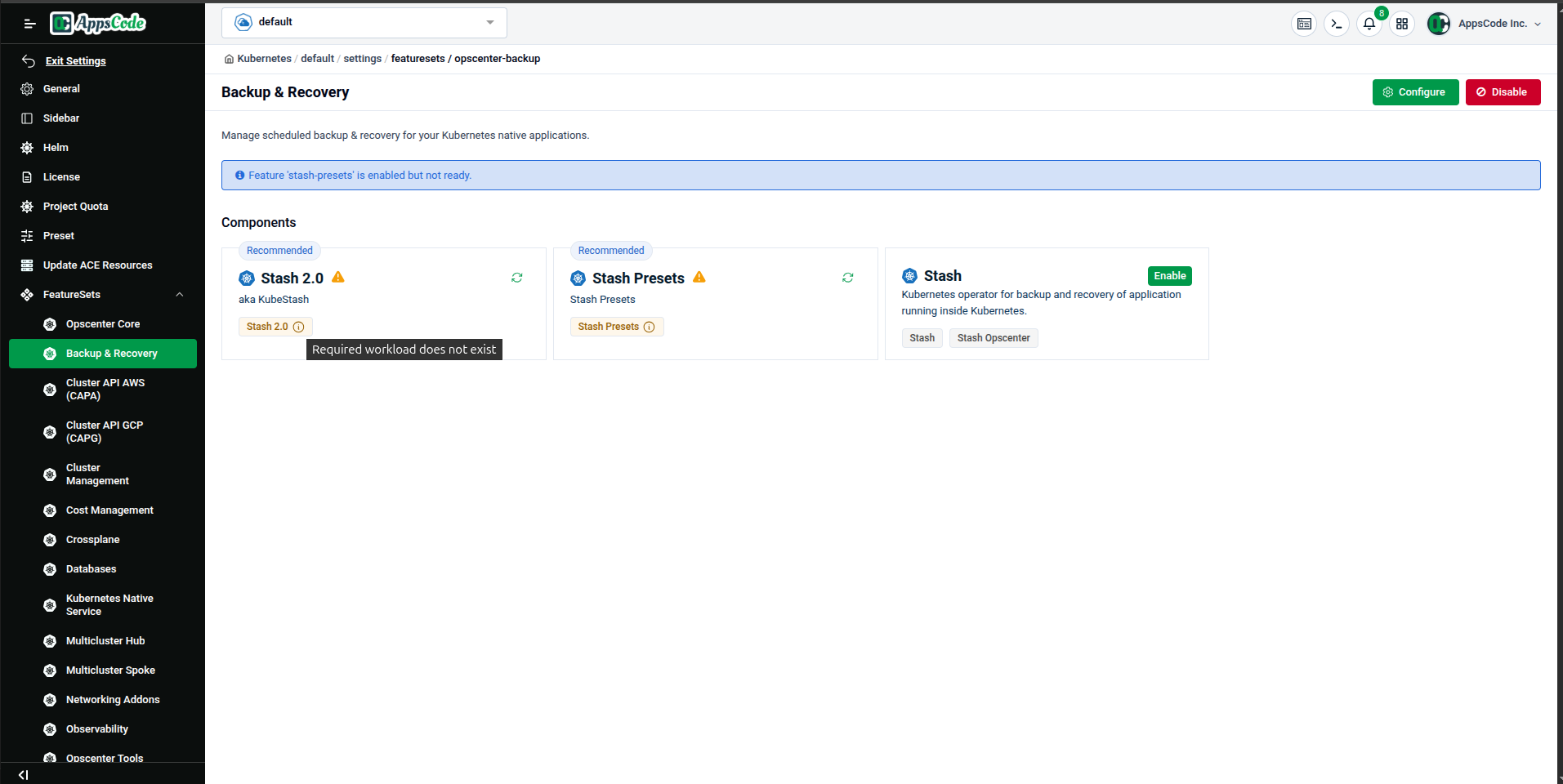
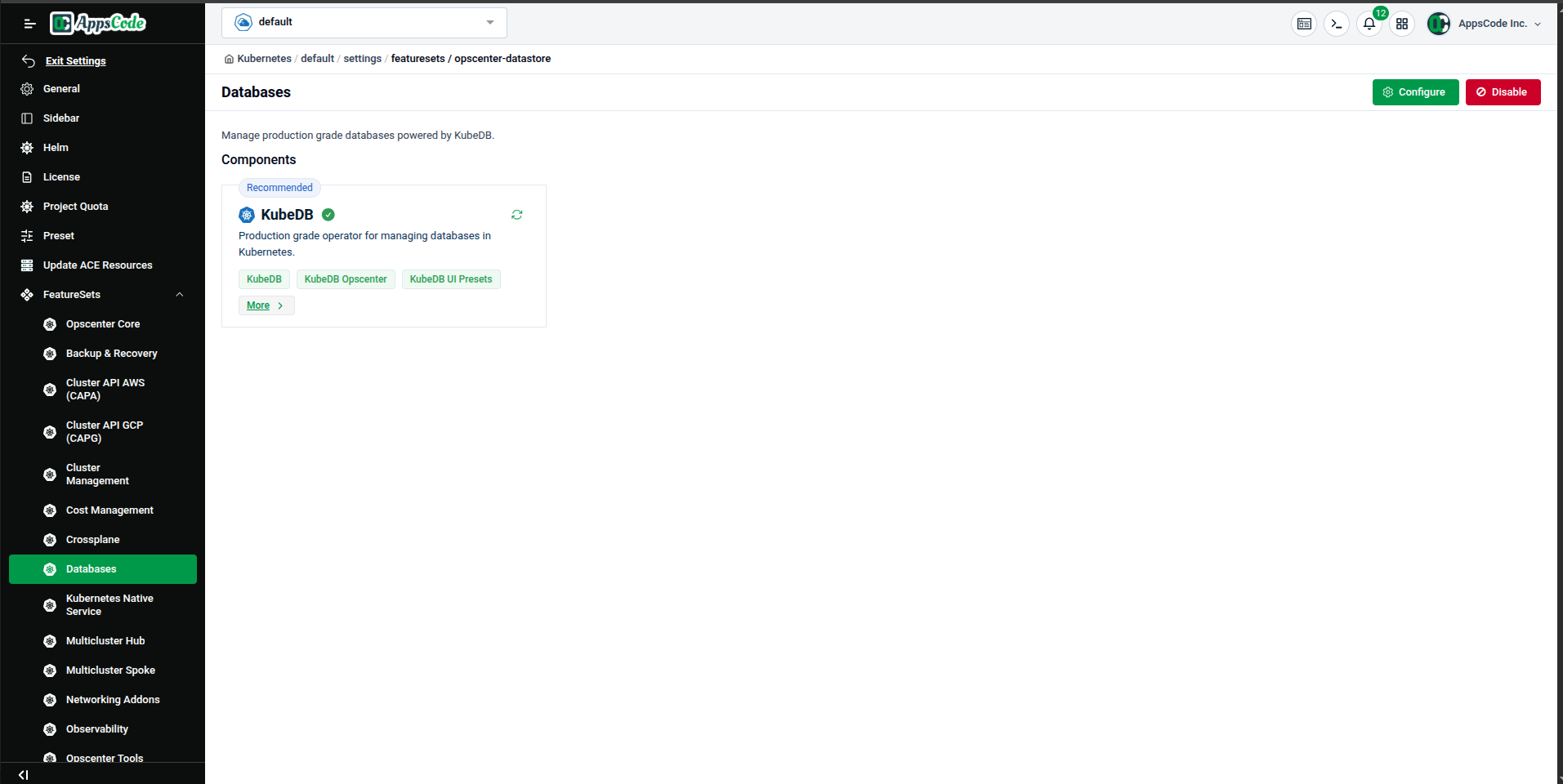
Once all components are running, all cards show a green ✓ checkmark and both Configure and Disable buttons appear at the top-right — confirming the Feature Set is fully Ready.
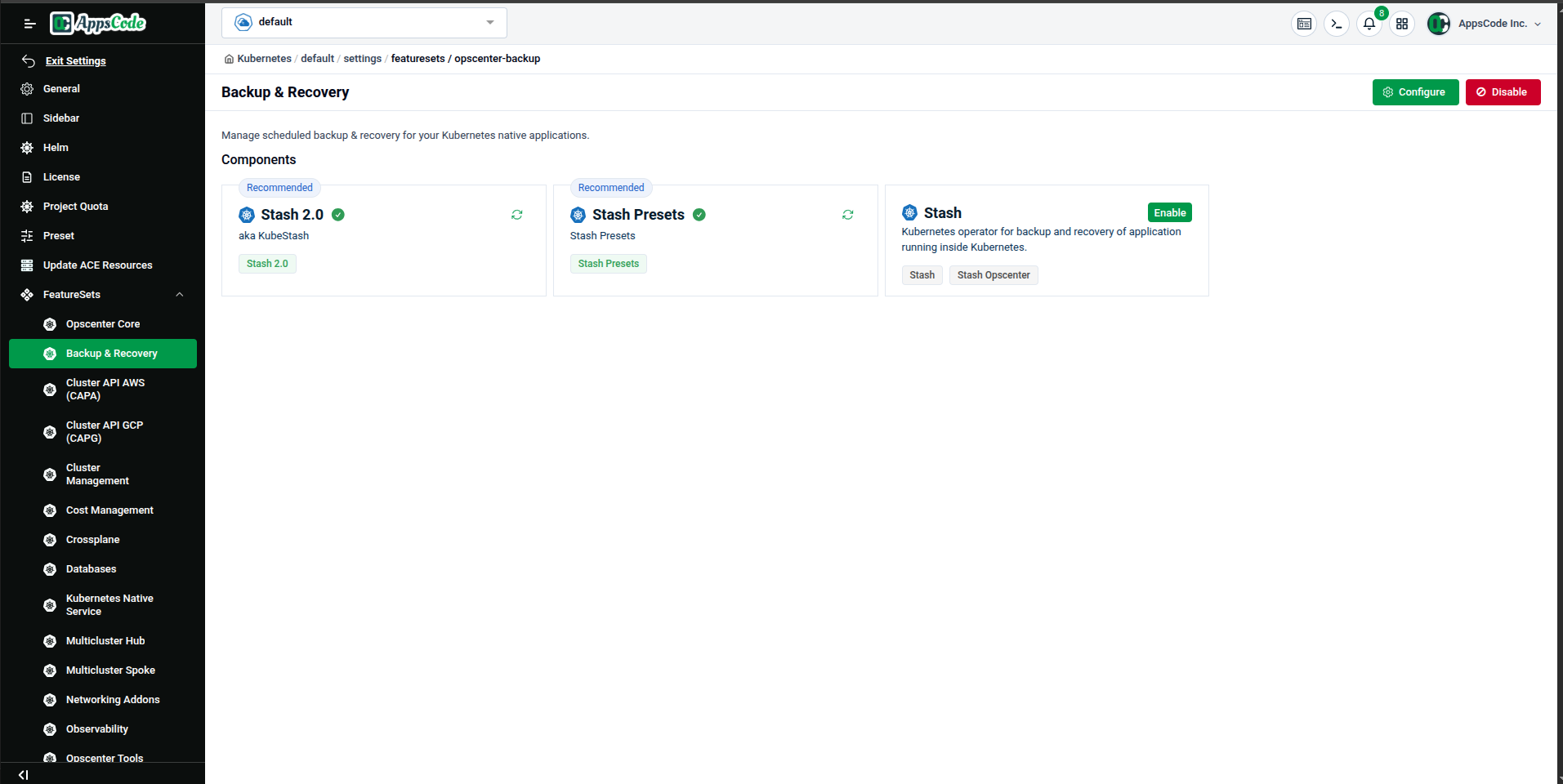
Feature Set: Databases
Databases enables production-grade database management powered by KubeDB. It supports a wide range of database engines and is managed by a single component: KubeDB (with sub-components KubeDB Opscenter and KubeDB UI Presets).
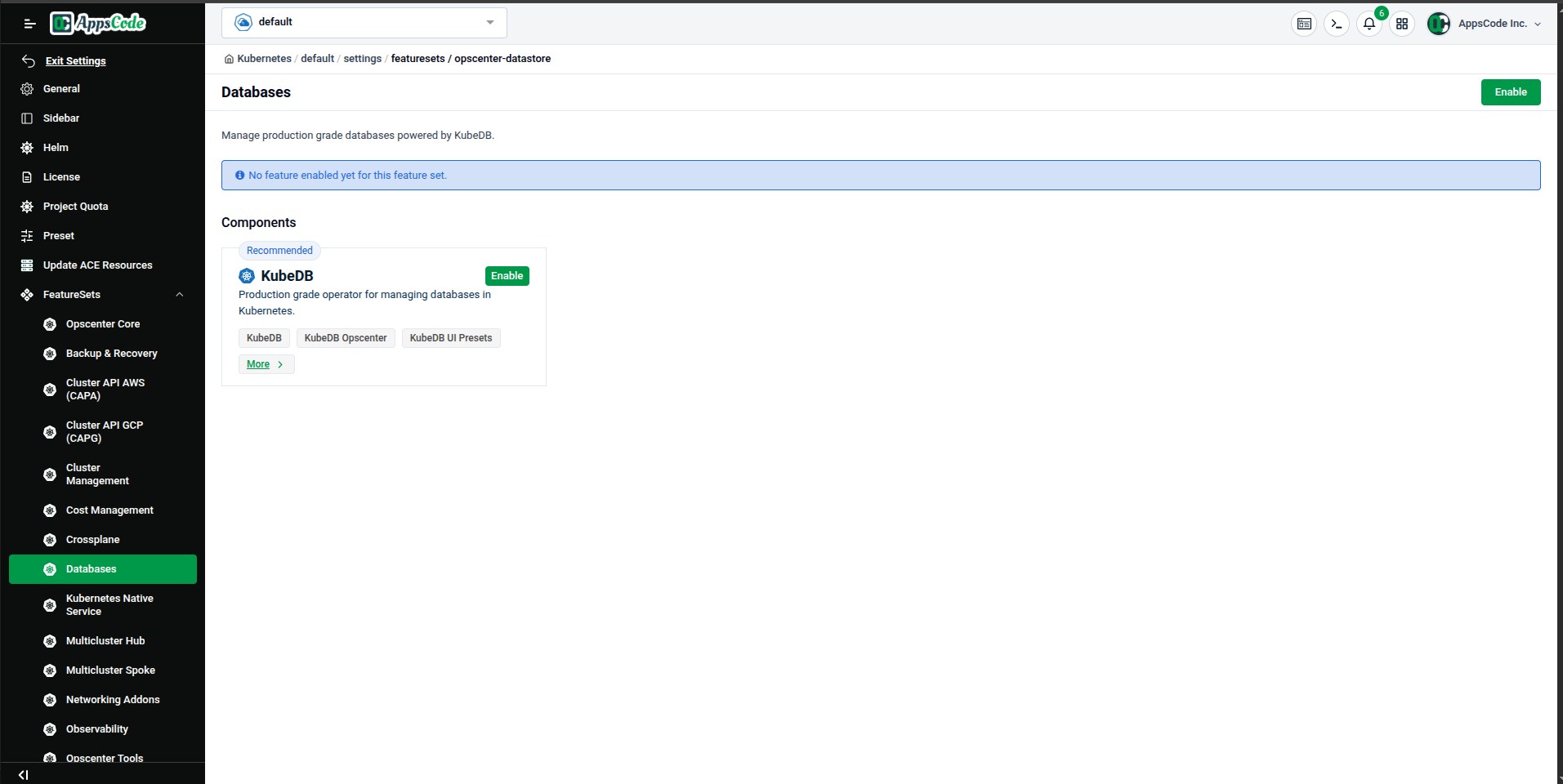
Step 1 — Open the Databases Feature Set Page
Click the Databases card on the Cluster Overview. The Feature Set page opens, showing:
- A blue info banner: "No feature enabled yet for this feature set."
- A single KubeDB component card (Recommended) with sub-components:
KubeDB,KubeDB Opscenter,KubeDB UI Presets, and More - A green Enable button on the component card and at the top-right
Step 2 — Select Database Types
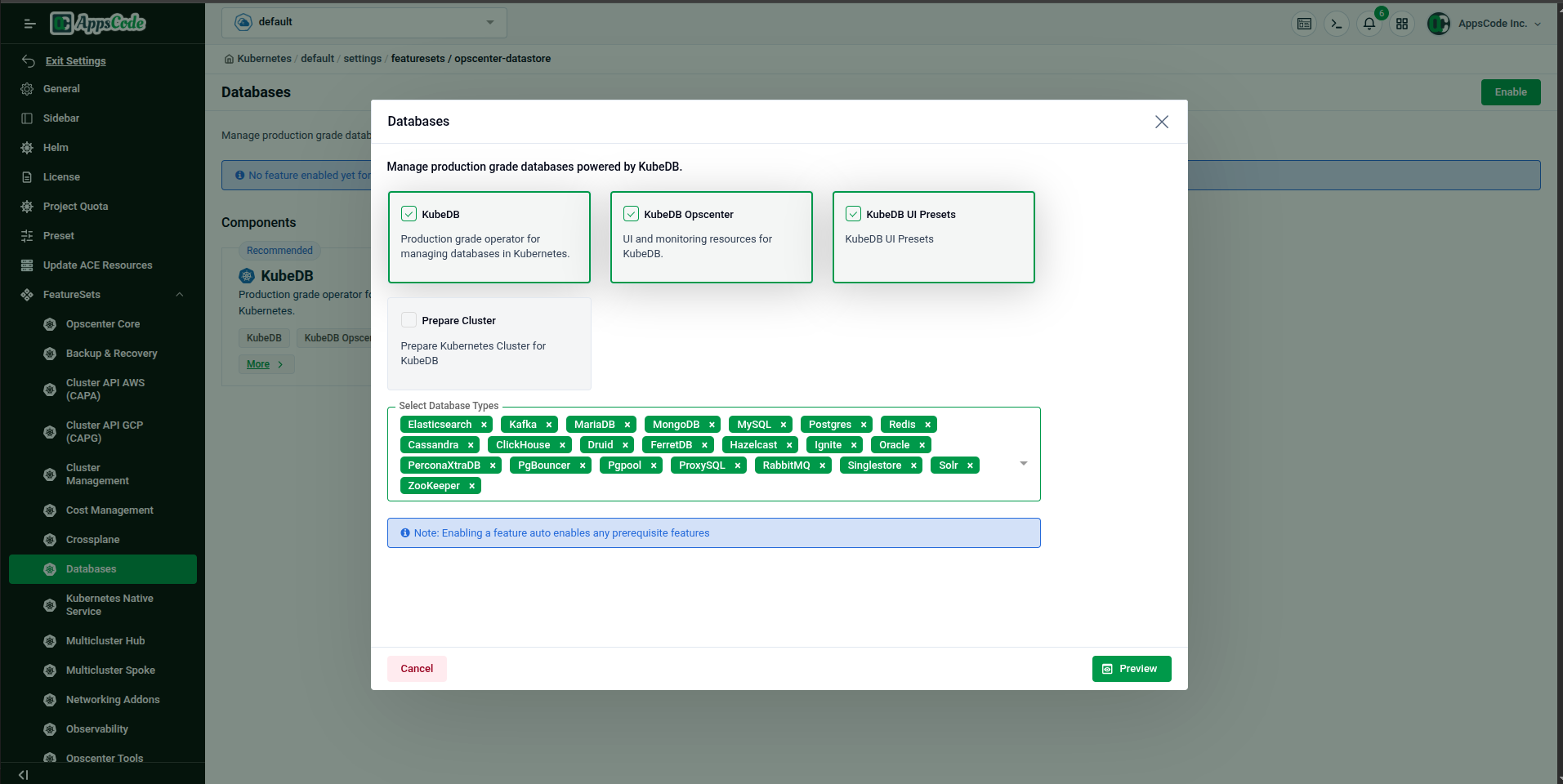
Click the Enable button to open the Enable Feature Set modal. The modal shows:
- A checklist of KubeDB components: KubeDB, KubeDB Opscenter, KubeDB UI Presets, and Prepare Cluster
- A Select Database Types multi-select field — choose which database engines to enable:
- Elasticsearch, Kafka, MariaDB, MongoDB, MySQL, Postgres, Redis, Cassandra, ClickHouse, Druid, FerretDB, Hazelcast, Ignite, Oracle, PerconaXtraDB, PgBouncer, Pgpool, ProxySQL, RabbitMQ, Singlestore, Solr, ZooKeeper
- A blue note: "Enabling a feature auto enables any prerequisite features."
Select your required database types and click Preview.
Step 3 — Review the Generated Helm Values
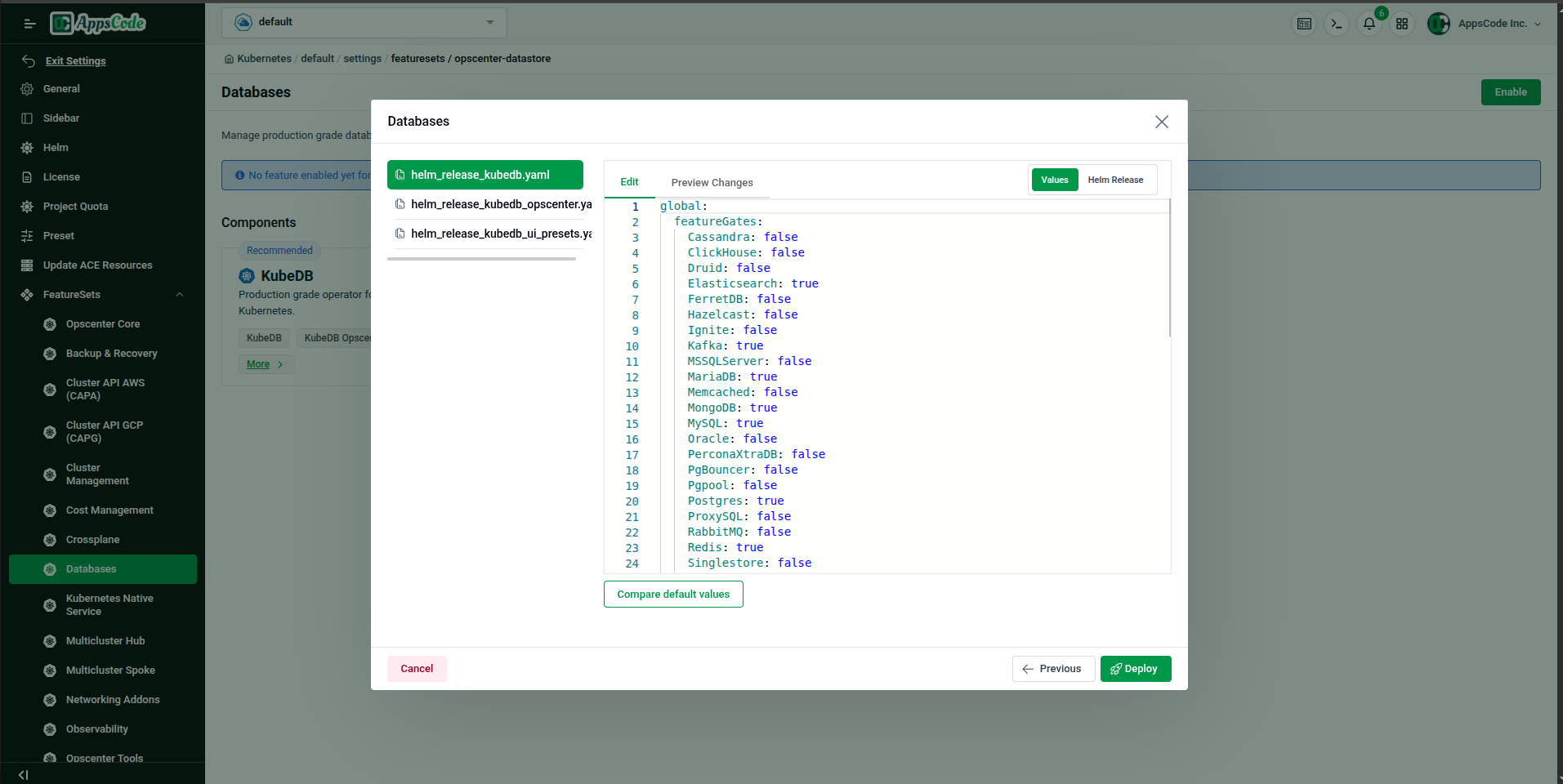
The modal advances to the YAML values preview. Three Helm release files are listed on the left:
helm_release_kubedb.yamlhelm_release_kubedb_opscenter.yamlhelm_release_kubedb_ui_presets.yaml
The YAML editor on the right shows the featureGates configuration — each selected database type is set to true, others to false. Use Edit / Preview Changes tabs to review, then click Deploy.
Step 4 — Deploy and Monitor Progress
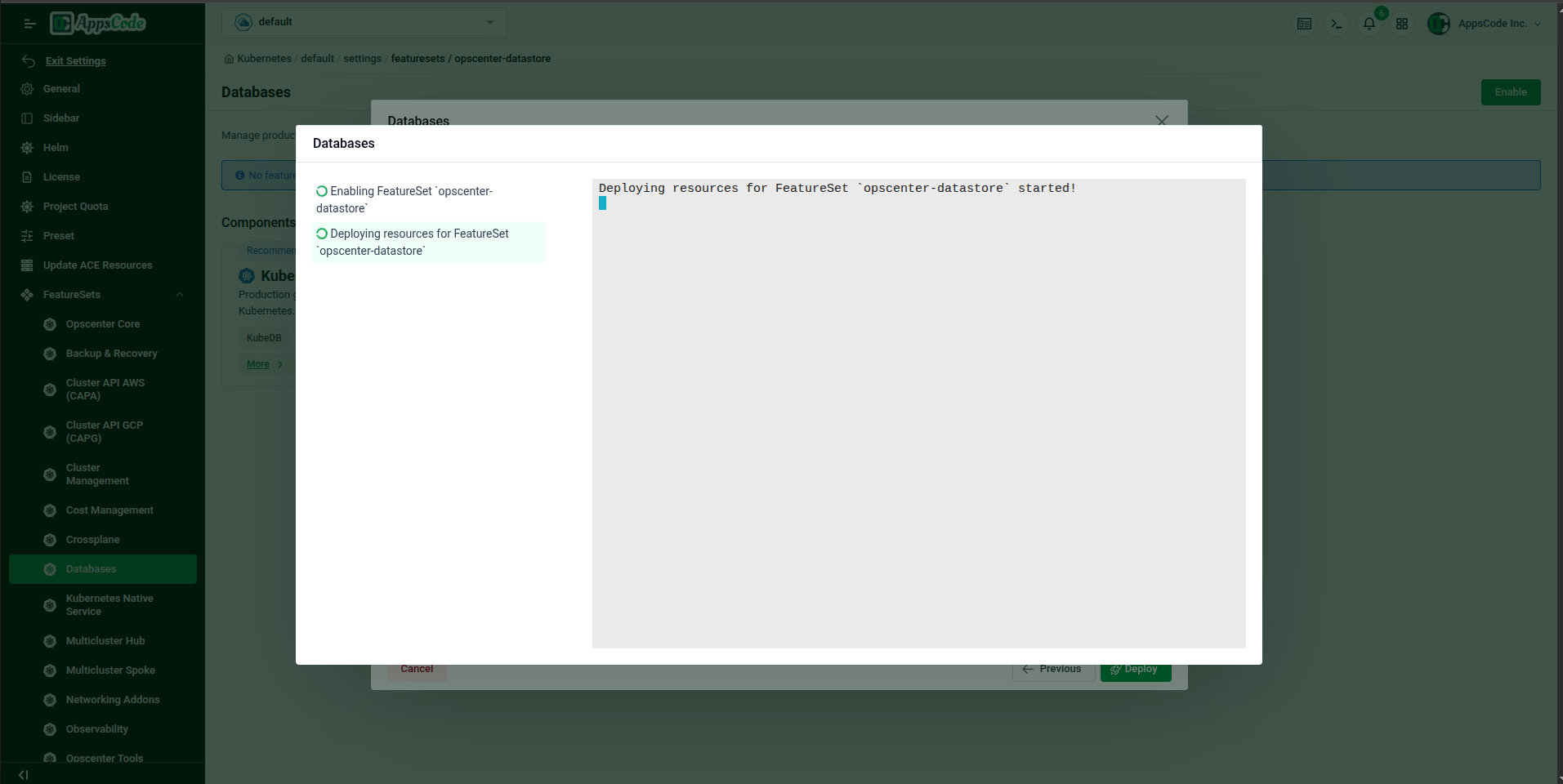
After clicking Deploy, the live deploy log shows:
Enabling FeatureSet `opscenter-datastore` started!
Deploying resources for FeatureSet `opscenter-datastore` started!
Wait for the log to complete, then close the modal.
Step 5 — Verify the Feature Set Status
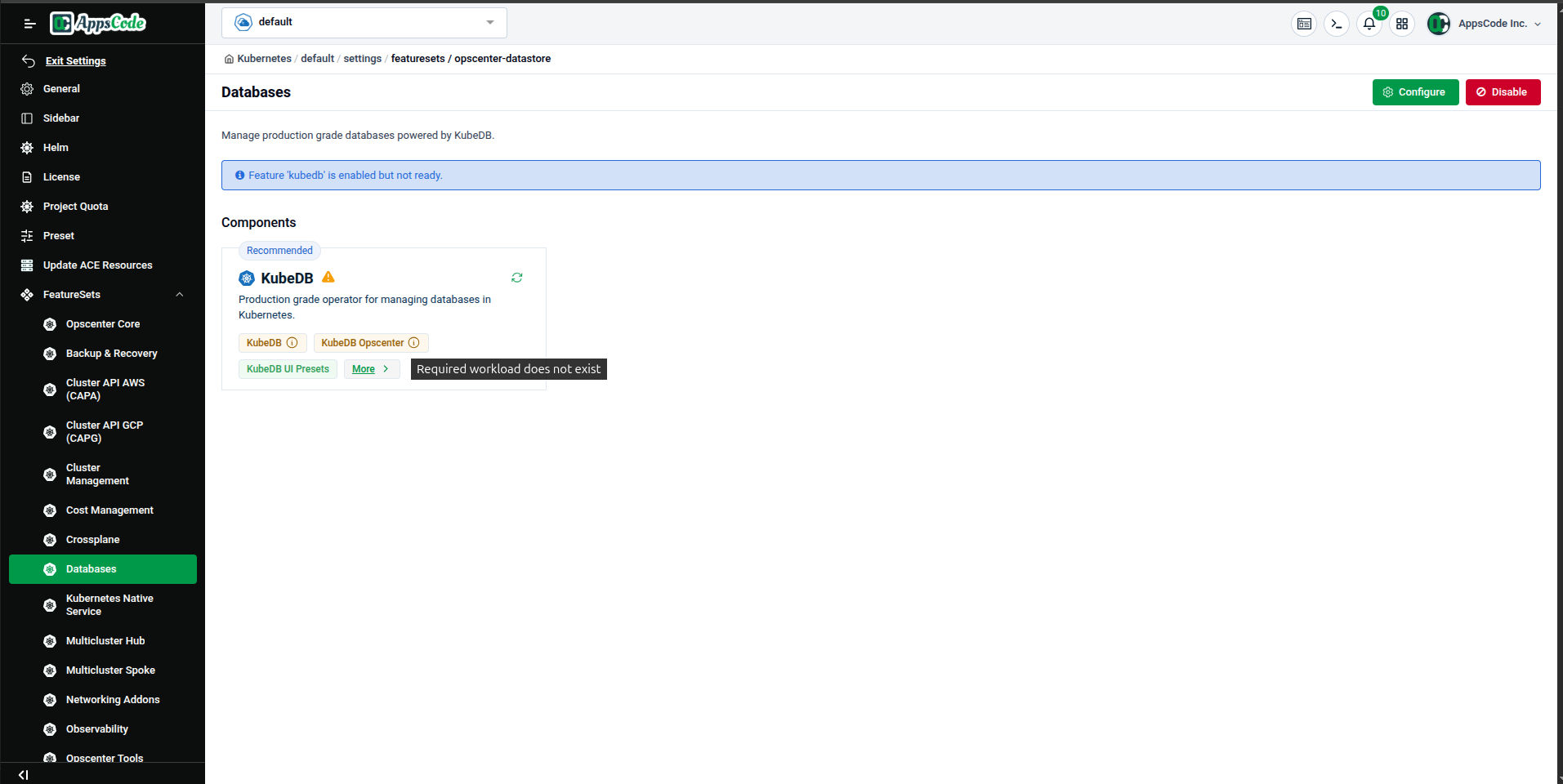
After deployment, the Databases page shows the KubeDB component status. While resources are still initializing, the banner reads: "Feature 'kubedb' is enabled but not ready." The component card shows a ⚠️ warning icon and tooltip "Required workload does not exist."
Once KubeDB is fully running, the component card shows a green ✓ checkmark and the page header shows Configure and Disable buttons — confirming the Feature Set is fully Ready.
Quick Reference
| Task | How to do it |
|---|---|
| View all Feature Sets | Cluster Overview → Feature Sets grid |
| Open a Feature Set | Click any Feature Set card |
| Enable a Feature Set | Click Enable → select components → configure → Preview → Deploy |
| Check component status | ✓ = Ready, ⚠️ = Not Ready, Enable button = Not Installed |
| Disable a Feature Set | Open Feature Set page → click Disable (top-right) |
| Reconfigure a Feature Set | Open Feature Set page → click Configure (top-right) |