







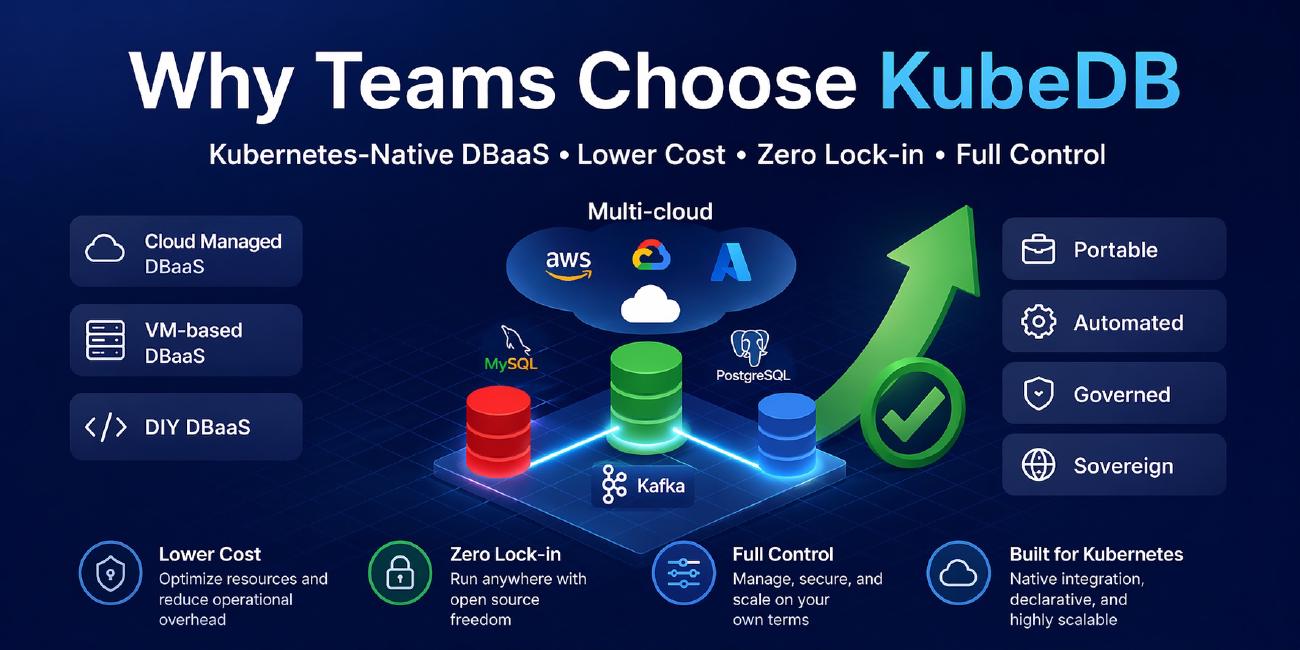
In the era of cloud-native applications, databases are no longer just storage. They are critical, always-on services that must scale, recover, and stay secure with minimal friction. Yet traditional Database-as-a-Service (DBaaS) options force teams into a painful trade-off: pay a premium for convenience (cloud-managed) or shoulder heavy operational toil (VMs or DIY).
Enter KubeDB, the Kubernetes operator from AppsCode that turns any Kubernetes cluster into a full-featured, self-service DBaaS platform. With a single declarative YAML (or a slick web UI), teams can provision, scale, backup, monitor, upgrade, and secure 20+ databases (PostgreSQL, MySQL, MariaDB, MongoDB, Redis, Elasticsearch, Kafka, SQL Server, and more) exactly like any other Kubernetes resource.
Teams choose KubeDB because it delivers the best of all worlds: cloud-like simplicity without the lock-in or 80–100% markup, VM-level control without the manual drudgery, and DIY flexibility without building the platform from scratch.
Here’s a clear, side-by-side comparison that shows exactly why KubeDB wins for most modern platform and DevOps teams.
KubeDB vs. Cloud-Managed DBaaS vs. VM-Based DBaaS vs. DIY DBaaS
The table below is ordered by importance to DBaaS decision-makers, starting with the areas where KubeDB delivers the strongest, most decisive advantages. KubeDB’s key advantages are highlighted in bold.
| Aspect | KubeDB (Kubernetes Operator DBaaS) | Cloud Managed DBaaS (RDS, Cloud SQL, Azure DB, etc.) | VM-based DBaaS (cloud or on-prem) | DIY (single operator/Helm/Ansible) |
|---|---|---|---|---|
| Cost | Low (pay only for Kubernetes nodes + storage) | High (80–100% markup on infrastructure + per-service pricing) | Medium (VM costs only) | Medium (but high engineering time/cost) |
| Portability / Multi-Cloud | Excellent (same YAML everywhere: EKS, AKS, GKE, on-prem, air-gapped, hybrid) | Poor (vendor lock-in + painful migrations) | Medium (cloud-specific images/scripts) | Varies (usually tied to your custom tooling) |
| Control & Customization | Very High (full config, custom plugins, any storage class, any Kubernetes feature) | Low–Medium (provider limits) | Very High | Highest (but you have to code it) |
| Latency / Performance | Excellent (databases run in the same pod network as your apps) | Good but cross-VPC/network hops possible | Good | Depends on your setup |
| Compliance & Data Residency | Excellent (run in your own VPC, air-gapped, or on-prem) | Good but data leaves your control | Excellent | Excellent |
| Supported Databases | 20+ broadest (popular open-source and enterprise editions) | Varies by provider (usually 5–10 popular ones) | Any (you install it) | Any (you install it) |
| Automation | High (provision → scale → backup → monitor → upgrade all via CRDs) | Highest (zero-ops) | Low–Medium (you script or use basic tools) | Low (you build everything yourself) |
| High Availability & DR | Built-in (operator + Kubernetes self-healing + automated backups via KubeStash) | Built-in | You build it (replication, failover, snapshots) | You build it |
| Operational Burden | Low–Medium (Kubernetes + operator handles Day-2 ops) | Lowest (fully managed) | High (you patch OS + DB, set up HA, backups) | Highest (you build + maintain the entire platform) |
| Time-to-DB | Minutes (just apply YAML) | Minutes (console/CLI) | Hours–days | Weeks–months (to build the service) |
| Expertise Needed | Kubernetes + DB knowledge | Minimal DB ops | Deep DB + OS + infra skills | Deep everything + platform engineering |
Why These Advantages Matter in Real Life
- Dramatic cost savings without sacrificing features is usually the #1 driver. Organizations moving from RDS or Cloud SQL to KubeDB routinely cut database spend by 50–70% while gaining more control.
- True multi-cloud and on-prem freedom eliminates vendor lock-in and future-proofs your architecture.
- Full control + Kubernetes-native automation means you get GitOps, RBAC, and declarative management for databases—just like the rest of your infrastructure.
- Co-located performance and compliance are non-negotiable for latency-sensitive apps and regulated industries.
KubeDB Use Cases: Real Enterprise Scenarios
KubeDB shines in production environments where teams need a portable, governed, and operationally consistent DBaaS platform. It powers the following high-impact use cases across hybrid, multi-cloud, edge, and sovereign Kubernetes setups:
Unified DBaaS Across Any Kubernetes
Databases can be deployed and moved seamlessly across on-prem, cloud, and edge infrastructures without re-architecting. Teams get a consistent experience everywhere—eliminating reliance on hyperscaler-managed services while maintaining full portability.
Automated Database Lifecycle Management
Provisioning, scaling, upgrades, high availability, and day-2 operations are fully automated through Kubernetes APIs. This slashes manual effort, reduces errors, and ensures identical management whether your clusters run in the cloud or on your own hardware.
Built-In Backup, Recovery, and Resilience
Application-consistent backups and restores protect stateful workloads out of the box. Teams can reliably recover data and support disaster recovery across multiple clusters—critical for business continuity in distributed environments.
Governance, Security, and Multi-Tenancy
Policy-driven RBAC, namespace-based multi-tenancy, and centralized access controls enable secure self-service database provisioning. Organizations enforce compliance and governance while giving developers the agility they need.
Data Sovereignty and Infrastructure Control
Deploy databases on-prem, in-region, or in fully air-gapped environments with complete control over data placement and storage. This meets strict regulatory requirements and avoids the limitations of external managed DBaaS offerings.
When Teams Should Choose KubeDB
KubeDB is the clear winner when your organization:
- Already runs (or plans to run) Kubernetes at scale across hybrid, multi-cloud, edge, or air-gapped environments
- Wants to treat databases exactly like any other Kubernetes resource (GitOps, ArgoCD/Flux, same CI/CD pipelines)
- Needs cost efficiency, true multi-cloud portability, or strict data-sovereignty and compliance requirements
- Requires a wide variety of databases under one consistent, battle-tested management layer with built-in governance and resilience
It runs on any Kubernetes distribution—EKS, AKS, GKE, Red Hat OpenShift, SUSE Rancher Prime, Nutanix Kubernetes Platform, VMware vSphere Kubernetes Service, bare-metal, or air-gapped environments—and works seamlessly with your existing Prometheus, Grafana, and storage solutions.
KubeDB is priced based on total memory allocated to managed databases, with a full 30-day trial available.
The Bottom Line
Teams don’t choose KubeDB because it’s the easiest “set-and-forget” option (cloud-managed still wins there). They choose it because it strikes the perfect balance—production-grade DBaaS power with dramatically lower cost, zero lock-in, and full control—while delivering real-world use cases like unified hybrid operations, automated lifecycle management, and sovereign data control.
If you’re running Kubernetes and tired of paying premium prices for databases you don’t fully own, or if you’re maintaining fragile VM-based or DIY setups, KubeDB is the modern, Kubernetes-native path forward.
Ready to see it in action? Deploy your first database in minutes with KubeDB and experience why thousands of teams have already made the switch.